
In Development from Capably Human
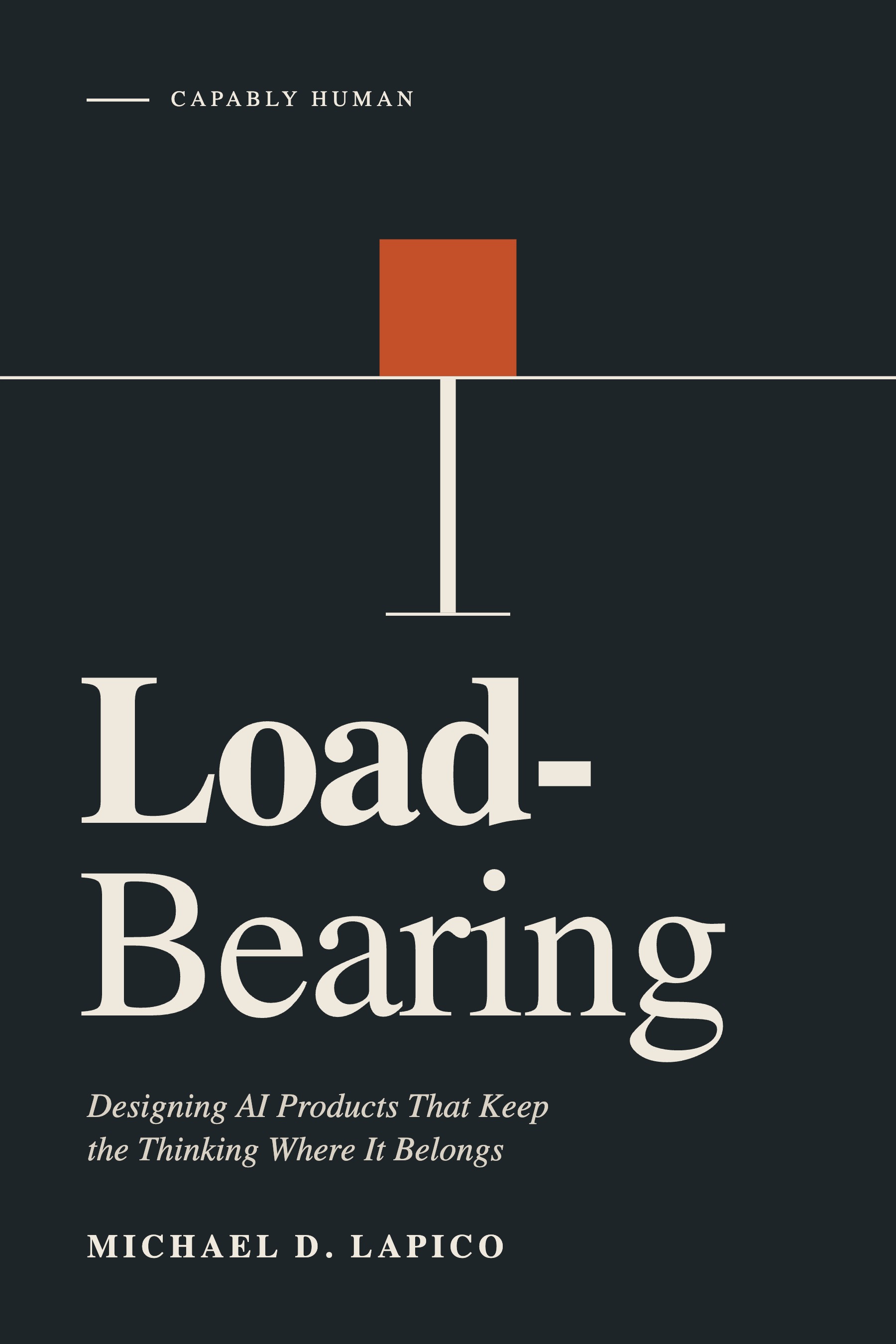
Load-Bearing
Designing AI Products That Keep the Thinking Where It Belongs
Michael D. Lapico
The second book in the series: a practical guide for product teams building AI features that keep the thinking — and the capability it builds — with the people who use them.
- AmazonComing soon
Hardcover · Paperback · Kindle
- Apple BooksComing soon
Ebook
In Development in hardcover, paperback, and ebook.
About the Book
Designing AI Products That Keep the Thinking Where It Belongs
Written for
- Product and design leaders
- UX practitioners
- AI product teams
Every feature teaches the people who use it a pattern of practice, and practice is how capability is built or lost.
Load-Bearing, the second book in the Capably Human series, is written for the people who decide what that practice is: product and design leaders and the teams building AI products.
It follows Heavy Lifting, which argues that the mind now needs its own fitness revolution and introduces the rules of engagement for working with AI: what to delegate and what to keep, when to trust and when to challenge, when to let it run and when to step in. Load-Bearing is the designer’s version of those rules.
Product Design Is Practice Design
You are always designing practice. The only question is whether you are doing it intentionally.
Interface choices, defaults, prompts, constraints, feedback, and timing all decide what the user does again and again. A tool that produces finished answers trains a different pattern of use than one that asks questions, offers staged hints, or supports revision. Neither pattern is visible in a usability test. Both compound over months.
What design decides
- Interface
- Defaults
- Prompts
- Constraints
- Feedback
- Timing
The first decision: support or substitution
The same feature can support a capability or substitute for it. Which one it does depends on the task, the user, the stakes, and whether independent capability matters in that context.
1
Does independent capability matter here?
Some work exists only to be finished — automate it. Some work is how the user’s judgment, understanding, or skill is built and maintained — that effort is load-bearing.
2
Who is this user, on this task?
A novice and an expert need different things from the same feature. Assistance that appropriately supports an expert’s oversight can strip a novice of the practice they haven’t had yet.
3
What is the user left able to do?
After a hundred uses of this feature, is the user more capable of approaching the task without it, equally capable, or less?
Rule 1
Decide support versus substitution deliberately, feature by feature. Both are legitimate; only one develops capability; the worst designs are substitution that believes it is support.
From Designing for Capability (CH-G-001), Capably Human
Read the guideHuman-Strengthening AI
Eight principles, as design rules
The objective is never to maximize cognitive effort — it is to keep the meaningful work with the person while removing the rest.
1
Attempt Before Assistance
People are encouraged to think, respond, or attempt before receiving substantial support.
Try this
Default to a blank input before the generate action: ask for the user’s rough take, framing, or guess first, even one sentence of it.
2
Questions Before Answers
The system asks when questioning develops more understanding than an immediate answer would.
Try this
Respond to vague requests with one sharp clarifying question instead of a confident guess.
3
Adaptive Friction
The effort needed for attention, learning, and meaningful participation is preserved; unnecessary difficulty is removed.
Try this
Audit each feature: list what effort it removes, then classify each item as incidental or load-bearing. Automate the first list; protect the second.
4
Progressive Support
Assistance is calibrated to the person and reduced as capability develops.
Try this
Decay the scaffolding: as a user succeeds without hints, stop offering them proactively; keep them reachable.
5
Visible Uncertainty
Established information is distinguished from interpretation, assumption, and speculation.
Try this
Visually distinguish sourced fact, inference, and speculation in generated output — three registers, not one.
6
Reflection After Action
People are prompted to identify what they learned and what they would do differently.
Try this
Add a lightweight reflection beat at natural completion points: one question, skippable, never a form.
7
Appropriate Delegation
Systems help people decide what to delegate to AI and what to keep as human responsibility.
Try this
Make delegation a visible, revocable choice rather than a silent default — show what the system did on the user’s behalf.
8
Capability Over Dependency
The system creates value without requiring permanent dependence on it; graduation is a success state.
Try this
Define a graduation state per feature: what would this user doing it unassisted look like? Instrument it and celebrate it in the UI.
From Designing for Capability (CH-G-001), Capably Human
Every technique, in the free guideThe Domain Lens
A design review in five passes
Walk your feature through each domain and ask what it asks the user to exercise, and what it performs for them.
What’s at risk
Framing, reasoning, evidence evaluation, judgment — the domain most directly at risk when the product supplies conclusions.
The design tell
Users paste a situation in and adopt whatever framing and answer come back.
The counter-move
Ask for the user’s framing first; show reasoning chains and assumptions; make evidence inspectable.
What’s at risk
Durable understanding. Fluent explanation is effortless to consume — and fluent input feels like learning.
The design tell
Users re-ask the same questions; nothing accumulates between sessions.
The counter-move
Prompt restating in the user’s own words; space and resurface past material; have users write their own summaries.
What’s at risk
Attention, persistence, effort regulation. Instant response trains intolerance for slow thinking.
The design tell
Every moment of difficulty has a one-keystroke exit, and it is always taken.
The counter-move
Hints before answers; protect flow from the assistant’s own interruptions; let users defer, not chase.
What’s at risk
Original ideas and voice. Competent-but-average output is always available as a substitute for the harder first step of one’s own.
The design tell
Users generate before attempting; iterate the prompt instead of the idea; voice converges on the model’s default.
The counter-move
Blank-first drafting; keep the user’s attempt alongside output; support revision of ideas, not just regeneration.
What’s at risk
Reflection, belief revision, feedback use — the domain that turns experience into growth.
The design tell
Output arrives, user moves on; the assistant’s affirmation is preferred to harder feedback.
The counter-move
Reflection beats; “what changed your mind?”; route real outcomes back to the user, not just completions.
The weakest necessary sub-skill sets the ceiling
A feature that develops five capabilities while silently eroding the one that binds them has not helped.
Healthy AI use is an outcome, not a feature
It emerges from strength across the domains plus deliberate delegation judgment. You cannot bolt on an “AI literacy” tooltip and call the job done.
From Designing for Capability (CH-G-001), Capably Human
The Capability Design Review
Ten questions to run against any feature that participates in users’ thinking
They work in critique, in a PRD template, or as a pre-ship gate.
What does this feature ask the user to do repeatedly — and what capability does that pattern build or erode?
Does independent capability matter in this context, for this user? If not, have we simply designed the cleanest possible automation? If so, which effort is load-bearing?
Does the user attempt before the system assists? What anchors the interaction — their thinking or our output?
Where the goal is understanding, does the system ever ask instead of answer?
Which friction have we removed, and was any of it the practice? Is there a one-keystroke exit from exactly the difficulty that matters?
Does support decrease as the user’s capability grows? What does this feature look like for a user at Prompted, and at Independent?
Can the user tell fact from inference from speculation in our output? Are the load-bearing assumptions visible?
Is there any moment where the user reflects, summarizes, or owns the reasoning — or does output arrival end the interaction?
Are delegation decisions visible, revocable, and weighted by stakes rather than convenience? What guards against oversight decay?
What would graduation look like for this feature, and would we recognize it as success in our metrics?
If a feature fails several of these and independent capability matters in its context, you are shipping substitution dressed as support.
From Designing for Capability (CH-G-001), Capably Human
Go deeper, free from Capably Human
- Guide · CH-G-001Designing for CapabilityA UX Guide to Building Products That Strengthen Human ThinkingRead it free
- Tool · CH-T-001The Rules of Engagement CheckA One-Page Tool for Working with AIRead it free
- Model · CH-M-001The Capability ModelA Working Model of the Human Capabilities That Matter in an AI-Enabled WorldRead it free
- Framework · CH-F-001The Capability Fitness FrameworkDefining a New Framework for Human Capability in the Age of Artificial IntelligenceRead it free
Early Readers
Read Load-Bearing before it’s published
Reviewers, journalists, booksellers, librarians, and educators can request an advance reading copy.

About the Author
Michael D. Lapico
For more than thirty years, Michael D. Lapico built technology meant to make things effortless. As a founder, Chief Product Officer, and design executive, he brought web and mobile products to market, from consumer apps to enterprise platforms, and built the first UX organization at an established enterprise technology company. Then AI made thinking itself optional. Now he is turning human-centered design on a harder question: how to build technology that makes people more capable, not less. He is the Founder and CEO of Capably Human, which he founded to pursue that question. He lives in Windsor, Ontario.
Also by Michael D. Lapico, from Capably Human
- Framework · CH-F-001The Capability Fitness FrameworkDefining a New Framework for Human Capability in the Age of Artificial IntelligenceRead it free
- Model · CH-M-001The Capability ModelA Working Model of the Human Capabilities That Matter in an AI-Enabled WorldRead it free
- Guide · CH-G-001Designing for CapabilityA UX Guide to Building Products That Strengthen Human ThinkingRead it free
- Tool · CH-T-001The Rules of Engagement CheckA One-Page Tool for Working with AIRead it free
- Model · CH-M-002The Rules of Engagement ModelThree Decisions in Any Human-AI InteractionRead it free
- Guide · CH-G-002The Rules of Engagement GuideWorking with AI at Work, at School, and in Later LifeRead it free
The Series
The Capably Human series
- Book 1 · Coming soonHeavy LiftingCapability Fitness in the Age of Thinking Machinesheavyliftingbook.com
- Book 2 · In DevelopmentLoad-BearingDesigning AI Products That Keep the Thinking Where It BelongsThis book
Press Kit
For press, booksellers, and event hosts
Cover art, the author’s photo and bios, and the book’s details, free to use in coverage of the book.
Downloads
- Front coverJPG · 1800 × 2700 pxDownload
- Author photoJPG · 1254 × 1254 pxDownload
- One-sheetBook one-sheetPDF · US Letter, 1 pageDownload

Author bios
Short bio (about 45 words)
Michael D. Lapico is the Founder and CEO of Capably Human. A product design leader since 1996, he is the author of The Capability Fitness Framework and Heavy Lifting: Capability Fitness in the Age of Thinking Machines.
Author bio (about 95 words)
For more than thirty years, Michael D. Lapico built technology meant to make things effortless. As a founder, Chief Product Officer, and design executive, he brought web and mobile products to market, from consumer apps to enterprise platforms, and built the first UX organization at an established enterprise technology company. Then AI made thinking itself optional. Now he is turning human-centered design on a harder question: how to build technology that makes people more capable, not less. He is the Founder and CEO of Capably Human, which he founded to pursue that question. He lives in Windsor, Ontario.
Contact
Talks, workshops, and team orders
Write to the Capably Human team about the book.
Talks & workshops
Sessions with Michael D. Lapico on designing AI products that strengthen the people who use them, for product, design, and engineering teams.
Team & bulk orders
Copies for product teams, design organizations, and courses.
Media & interviews
Interview and podcast requests, and review copies for journalists and reviewers.
Launch Updates
Be the first to know when Load-Bearing is published
Leave your email and we’ll let you know when the book is available to pre-order and buy.